Sunday, 22 December 2013

Best Restoration Project 2013


We are delighted to announce that Victor XL231 'Lusty Lindy' has received the 'Best Restoration Project' Award from Aviation Xtended - Europe's premier aerospace internet radio programme!

2013 has been a significant year for '231 and the team; with us marking 20 years since Lindy made her final flight and the honour and responsibility for her upkeep passing to myself and the team. With no RAF Stores at hand or Government financial backing to help look after a V-Bomber there have certainly been challenging times. But 20 years on, three re-paints under my hat and an intimate knowledge (yes, I have been in places you would not even believe possible!) of the air frame and systems I'm proud to say that Lindy is as serviceable as she has ever been.

Lindy proved that at 52 years old and having left the RAF 20 years earlier she still had what it takes to wow at her anniversary run in November.
XL231 anniversary run
However, maintaining a complex, 4-engine bomber is an on going feet, we will be sharing our journey on here and on XL231 work diary on the Key Forum as always please do drop us a line if you can offer any support - from picking the brains of ex-ground and aircrew, giving a financial or material donations, making flapjack for the team or lending a hand with a job we really do appreciate it. Thank you for your support in 2013.

The other very well deserving category winners were:

Helping the Aviation Industry – ‘Dragons of Thin Air’ by Doug Worrall http://dragonsofthinair.com

Best Restoration Project – Victor XL231 http://victorxl231.blogspot.co.uk/

Best Online Resource – LiveATC http://www.liveatc.net/

Best Aerospace Book – Avro Vulcan 60th Anniversary http://www.vulcantothesky.org/

Best Product for The Aviation Youngster – Jim the Jet Provost by Amanda Cundall http://www.jimthejetprovost.co.uk/

Best Pilot Product – Drift Ghost Camera http://driftinnovation.com/drift-ghost/

Best Aerospace Watch – Bremont MB http://www.bremont.com/chronometers/range/mb

Best Local Airfield – Compton Abbas http://www.comptonabbasairfield.co.uk/

Best Aerospace Clothing – The Basic Six t-shirt collection http://www.basicsix.co.uk/

Best Family Day Out – South Yorkshire Aircraft Museum http://www.southyorkshireaircraftmuseum.org.uk/

Best Software or Game – Airport Madness 4 http://www.bigfatsimulations.com/


Best Aerospace Product – The Big Book of Flight by Rowland White http://www.rowlandwhite.com/


Do check out Aviation Xtended at http://aviation-xtended.co.uk/ and give them a follow on Twitter @AviationXtended


Tuesday, 17 December 2013

Rear Crew escape system

Due to high costs it was decided that it would not be practical to fit Ejection seats for all crew members in the V Bombers.

Martin Baker did trial a full crew ejection seat system but due to varying reasons ,it was not put into production.

A system was therefore developed to assist the rear crew to be able to get out of the aircraft fast in an emergency situation.

This involved the development of a swivel 'Assisted Escape Seat' and this was retro-fitted to all Mk1 and Mk2 V Bombers after a number of fatalities caused by fixed non-swivel seating.
Assisted Escape Seat

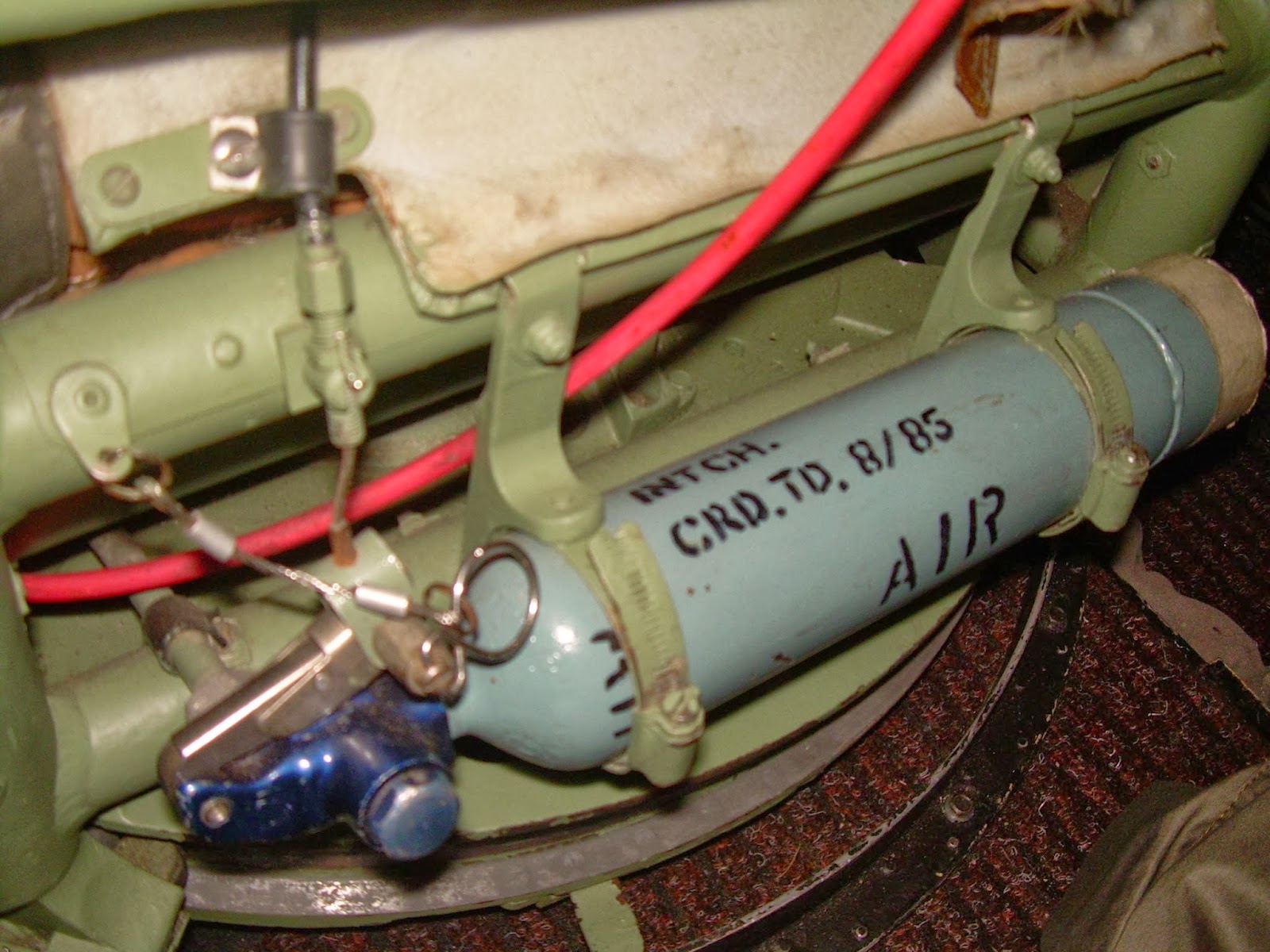
The seat was fitted with a powerful spring loaded back rest and a 'booster cushion' under the seat occupant. In order to operate the system the occupant turned the seat to face the door and pulled a yellow and black handle.


This discharged an air cylinder into the cushion which 'lifted' the occupant to his feet. But in order to vacate the aircraft the spring loaded back rest was sprung forward literally pushing and lifting the occupant to his feet and forward towards the open door. Prior to this the door had to be opened and in an emergency could be blown open by operating a door 'blow open' system operated by a shielded operating lever in the front of the AEO/NAV table.

Emergency door opening lever

Once out of the seat and pushed forward the seat harness lap strap was detached from the seat and the occupant was heading out of the door attached to his parachute, emergency oxygen and PSP (personal survival pack). In order to clear the aircraft the leading portion of the crew door was thus designed to create a 'stall area' allowing the crew member to drop safely clear of the lower lip of the engine intakes.
Open crew door

This system was successfully used in genuine emergency situations.

I have spoken to many V Bomber aircrew over the years about the pro's and con's of the pilots having ejection seats. The general consensus how I interpret it, is that no pilot would ever leave his rear crew behind unless there was no practical hope that they would get out, such as the Vulcan accident at Luqa, Malta in 1975 where only the pilots were able to get out.

Bulbs and Fuses

As time goes by naturally consumables get used up.

Two such items that are essential to the upkeep of XL231 are bulbs and fuses. Mundane to some but essential to us. In fact some fuse sizes are more or less impossible to find now, so we naturally 'rob' aircraft about to be scrapped and generally try to find consumables from wherever we can.

If anybody is looking for a home for any bulbs and fuses regardless of amperage then please let us know!
XL231's original AEO's spare bulb and fuse box

HF, ADF & Radio testing


On Sunday Rick Gill tested the recently serviced HF (High Frequency) radio and ADF (Automatic Direction Finding) systems out and satisfied himself that between us we had them well sorted. In addition he ran the VHF & UHF systems and again all were fully up to speed.


We all know that XL231 is unlikely to fly again and some of these systems are not necessary for us to be able to operate the aircraft.  However, XL231 is a historic and rare machine and she justly deserves to be as serviceable as possible. As her owner of 20years I probably know the type as well as is possible to do so and I personally would be more than confident in her ability to go airborne.

Sunday, 1 December 2013

Post Taxy run servicing HF Radio set

After a successful 20th Anniversary celebration it was back to servicing and maintenance.

The first job to tackle was replacing the HF Radio transmitter/receiver with a unit obtained from a 'straight out of service' VC-10.

XL231's original unit is in good condition but a little weak on transmission, so we decided to replace it with a better unit as we had managed to finally obtain a spare.

The unit is the 618T, originally a Marconi badged item but later a Collins unit and it is an extremely powerful item of equipment. Used in many military aircraft, it is one of the few HF radio's that is available. It is also a very bulky and heavy item.
618T mounting tray

618T control panel, middle top

Replacement 618T fitted

During the Falklands War of 1982 it was this type of HF radio that the AEO in Vulcan XM607 used to contact the UK in order to confirm the successful operation to bomb Port Stanley Airfield.

Tuesday, 26 November 2013

20th Anniversary Taxy run

The 25th November 2013 was totally different day to the 25th November 1993. The weather was 'balmy' and almost spring-like and we didn't mind one bit!

Press and TV presence was plentiful and myself, Ollie Suckling, Al Stephenson and Brian Watmough all spoke to the camera.

ITV News Footage

Modern technology ensured the aircraft was getting the coverage she deserved in the fact that Lionel from Driver Skills.com on the airfield was able to employ his state of the art suction cameras all over the aeroplane. In addition to this he utilised his flying 'eye in the sky' camera platform. Any aerial footage on the day was thanks to Lionel. In addition to Lionel's cameras the TV companies installed their own and extra cameras were supplied by Ollie Suckling.

The first aircraft to run was the Nimrod and her crew put on an impressive display. We crewed into the Victor at 13.00 hrs and started engines at 13.25

Ollie slow taxied two circuits of the former V Bomber QRA pan at the end of the runway before a short blast of power and a gentle taxy down to the end of the runway for the main display.

The brake check crew comprising of Andy, Rick and Kayleigh gave the thumbs up for 'GO' after a quick once over and we then waited with engines idling for the correct time of 14.16 when she actually touched down. In fact we had been early so, we had over 10 minutes to wait.

At 14.15 and 30secs Ollie wound the engines up to 88% for a brake slip check and she stuck like glue to the spot with the weight of thrust burying her nose downhill. Satisfied that the brakes were good he then put the power on and up to 103% Combat Setting. The nose lifted and she accelerated like a rocket up to 110knots with myself calling out the speeds. Ollie then cut power and streamed the tail braking parachute. There were no crosswind problems and all was good. At first Ollie thought it was a 'no stream' as the pull was gentle at first but the pictures prove otherwise!

We carried the chute the full length of the runway with the inboard engines keeping the chute inflated and just before turning into the V Bomber QRA for shutdown the chute was jettisoned. I'm pleased to say it detached cleanly and dropped flat without apparently tangling the rigging lines and we turned in for shutdown checks and final closedown.

During the run the aircraft displayed no snags, all 4 engine alternators were on line and producing enough power for a small town and all other systems were normal. 20 years ago the Senior Engineering Office of 55Sqn, Sqn Ldr Sargeant suggested XL231 as a good bet for purchasing as she was one of the more reliable squadron jets. I'm glad we took his advice!

Once the shutdown was out of the way it was time to meet the press and TV, then Lindy herself had a good drink of champagne and we congratulate ourselves on a successful day.

It has been a privilege to operate and care for such a rare and charismatic aircraft, I hope we can keep going a good while yet!
 
The crew for this historic day were;
 
Captain, Flt Lt Ollie Suckling.
Co, Andre Tempest
AEO, Sqn Ldr Alan Stephenson
6th seat, Sqn Ldr Martin Withers DFC
Nav plotter, Mrs Christine Watmough on her Birthday!
Nav Radar, Sqn Ldr Mick Beer (standby AEO)
Crew Chief, Grant Sparks


Victor XL231 photo 'Nightshoot'

As part of the 20th anniversary of XL231 retiring from the RAF and 'retiring' to Elvington it was decided to take the opportunity of the crisp and clear weather to carry out a private nightshoot of the aircraft.

Myself, Olly Suckling and Gary Hancock donned suitable attire for the evening and posed as the 'models' for this significant event.

The private photoshoot was covered by Ian Finch, Andy Abbott, Andy King and Graham Buckle. I'm sure you'll agree the results speak for themselves!

The sky was gin-clear and the star patterns were all clearly visible and yes, it was cold!

As part of the pre-taxy checks for the following day we decided to function systems on the aircraft and she threw a little spanner in the works. Our mistake it turned out but, it caused a mild flutter of panic!

The nose wheel steering is only operable on internal hydraulics ie the pumps being run by either the APU or main engine electrical busbar supplies and this we know. However, with ground power on and hydraulics running then the nosewheel steering is in-active. Normally we use an older type ground power unit and it does not matter if the lead is still attached to the aircraft but, this time we were using a more up to date item and its interlink system took out the steering. We naturally were concerned and after shutting the aircraft down deduced the ground unit was the problem. We then re-started and physically removed the lead once the APU was on line and thankfully all was then back to normal. It is quite surprising how running such a complex aircraft at night has a totally different perspective on daylight operations.