Following on from overhauling the amplifiers with new spec capacitors I decided to give them a try on the Victor, using the fuselage gauging circuit to test them out, each one was plugged in one by one to test their operation and accuracy. Unfortunately (for me) I was alone and that meant I had to clamber up and down the wing at least seven times in order to trip the AC power supply in the cockpit in order to safely swap the amplifiers over. After much effort and feeling like a 'One man band' I concluded the repairs had gone well and 6 out of 7 repaired amplifiers tested and indicated fuel contents. However due to slightly different spec capacitors the expected levels were not quite correct so, trimming of the circuits was required. I was however satisfied that I had got somewhere, if this repair had not worked then, there were no further options to go for... Further encouraged I carried out similar repairs to 4 more amplifiers. There are more to do so we should end up with around 6 spare units.
Ollie 'volunteered' to come in on Sunday to operate the fuel gauge test set and we set up internal intercom so that we could liaise without problems. Ably assisted by Rick Gill, Ian Finch, Rich Spaven and John Hawkridge we got into the task.
The 5 fuel tank groupings, Port wing, Fuselage, Stb'd wing, Fwd bombay, Aft bombay
Amplifier, Type LA15 with cover removed and plugged into the test set
Smiths fuel gauge test set Type QC32 on the plenum chamber floor
Ollie tested each amplifier on the test set for voltage & power consumption and then using the two capacitance trimmers within the amplifiers he set the low level and high level readings with myself tripping power on and off in the cockpit as required. Once a full set of 8 trimmed amplifiers had been achieved Ollie installed them one by one and I followed by installing the associated fuse and then observing the fuel gauge movement. On power up, the gauge is driven to zero and then is driven to the fuel level within the tank or tank grouping, depending on the circuit. We concluded that the port wing grouping is serviceable as is the port underwing tank, the fuselage tanks circuit is serviceable, the Starboard wing grouping appears to be out of trim or has a signal cable snag so that requires working on and the Stb'd underwing tank circuit is serviceable. The forward Bombay tank gauge has a fault that appears to be within the gauge and this will require replacing and the Aft Bombay gauge is working but requires trimming to the correct level on the Bombay cable box trimmer. The Port and Starboard underwing tank level repeaters situated on the Navigators panel are serviceable, as is the total contents Totaliser gauge.
The dedicated team members closing the jet up in the twilight after a satisfying and succesful Sunday
The fuel gauging on the Victor works on a capacitance fuel reading system, meaning there are no fuel level floats in any of the fuel tanks. The fuel is measured by a capacitance positive and a capacitance negative column. These are tubes with no moving parts extending from top to bottom in the tank and work on a 'Wheatstone Bridge Principle' by reading level changes by a change in capacitance in the fuel itself. The reading is transmitted to the fuel gauges by co-axial cabling via an amplifier that drives the fuel gauges at 115volts AC/400Hz. The system is very sensitive and requires absolutely reliable parts in order to be accurate.
The amplifier units are full of valves, capacitors and resistors and with old age become unreliable. Effectively these items are still being expected to work 20 years after the expected end of useage!
Original Spec capacitors
Replacement capacitors
All of the spare amplifiers that we recovered from scrap aircraft have now being used up and the ones in the aeroplane were starting to weaken with low and stagnant indications. Therefore it called for drastic action and 'The Brains Trust' got to work (namely Ken 'Radio' Sanderson) who came up with the up to date replacement specs for the capacitors. Some are no longer available down to the absolute identical spec but, we've found every type to replace them. There are 9 in each amplifier and much 'soldering & burnt fingers' has resulted in a batch of 6 out of 7 repaired ones now working, There are more to do now the formula has been set! The next job is to fine-tune them with the fuel gauge test set before they are fitted back into XL231.
The Green Satin Doppler navigation system had been playing up for a while and as there were no spares we couldn't do much about it.
However recent spares acquisitions brought 2 control units and one was removed from XL231 in May 1993 for probably bay servicing. The Form 731 was signed by Andy Price, the same Andy price that painted 'Lusty Lindy' on XL231 and who also painted the other Gulf War Victor 'Nose Art'.
The original unit was removed and within seconds of switching on the replacement it was obvious it was working in some capacity, the speed ran down to zero and the memory lamp went out after a while (it was stuck in memory on the old unit). Drift began to indicate and the neon row of lamps started to work. 100% better than the old unit. I then switched off because the cooling fans need to be checked on the Computer and Transmitter/Receiver trays before we go any further. These are located in the rear freight bay. However, all signs seem good!
A colleague on the Victor Team (Corporal Andy King) obtained these from a fellow armourer who had removed them from Gulf War veteran XL164 'Saucy Sal' after she had been retired for crash rescue duties to RAF Brize Norton and they have now been donated to XL231 by him.
Top; Mk17F Oxygen regulator, Below Main Voltage Frequency Meters (400Hz), MV Voltmeter (200v AC) and Jet Pipe Temperature for the Rolls Royce Jet Engine (APU) Auxiliary Power Unit.
Spare parts are vital for the long term well being of XL231 as she is far from being a 'dusty museum exhibit'.
XL164 survives as a cockpit section only which is a great shame as she was the lowest houred Victor K2 on 55 Squadron.
Much needed spare parts continue to be donated and acquired for XL231's continual survival as a working 'live' aircraft.
Some parts are generic and some are totally type specific for the Victor K2, it is the latter that we are always keen to obtain. The below have been kindly donated by The Vulcan Restoration Trust (VRT) at Southend and were removed from Victor K2 XH671 'Sweet Sue'. She saw heavy action during the Gulf War of 1991 and sadly was written off at RAF Marham in 1993 after the crew door blew off during a routine cabin pressure test. She was however displayed statically for HM The Queen's Review at RAF Marham with the door 'lashed' back on for the parade because she had been cosmetically prepared ready for the event beforehand. She was scrapped soon afterwards.
XH671 'Sweet Sue'
Type specific parts include these; They are the automatic control boxes for 2 Victor Conway engines and left to right are; Start in Progress light and Turbine Overspeed control, Engine Air Bleed Valve control and the large lower unit; Jet Pipe Temperature (JPT) Control Amplifier. The first unit is basically to provide a rotation light for the pilot during the initial stage of engine start, it doubles up to warn the pilot of a turbine overspeed of the engine at high power and he would immediately reduce the power setting in order to protect the engine. The second unit closes an air bleed from the engine at a power setting of 88% and above ( the power setting is used to determine if the engines are 'serviceable' for takeoff). Air bleeds are used for cabin pressurisation, bombay heating and anti-icing etc. But need to be closed during takeoff as any air being bled off reduces the engine power output. The valves re-open once the power is reduced after takeoff etc. The JPT amplifier automatically controls the temperature of the exhaust gases to keep the temperatures within limits at all power settings. However this can be manually over-ridden by the Captain if required.
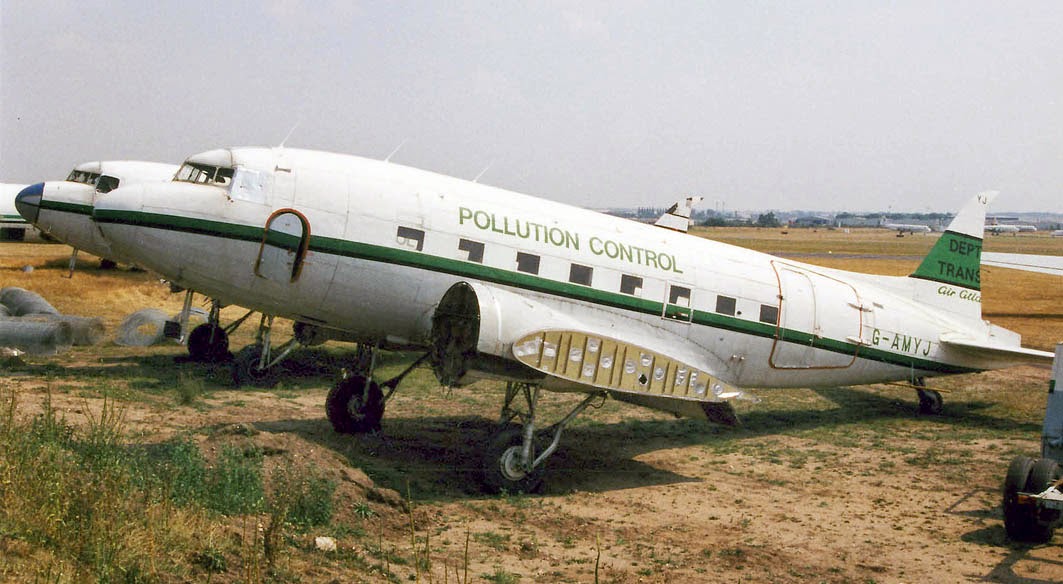
Douglas DC-3 Dakota G-AMYJ (KN 353) was retired from flying in 1999 by Air Atlantique at Coventry and used as a spares source for the remainder of the fleet. She was acquired by YAM in 2001 as an engine-less shell with the Stb'd outer wing missing.
She arrived on low-loaders and was pieced back together by a small team led by ex-RAF Senior Engineering Warrant Officer George Astley MBE.
G-AMYJ on the dump
The restoration initially was for static display and she was fitted with incorrect ex-Catalina engines and props. The interior was fitted out for 'paratrooping' and the cockpit pieced back together for static display.
As time went on it became clear that it was possible to bring her back to 'life' and two correct Pratt & Whitney Twin Wasp engines were acquired via Air Atlantique as well as flight-worthy propellors. These were installed late in 2009 and a restoration programme was started including a complete rubdown and repaint carried out by myself and Peter Kondras in 2011 into correct RAF Olive Drab colours.
The task to resurrect her was vast, The electrics were in a mess and a number of hydraulic, pneumatic and engine components were missing or U/S.
The team came together for the task and included; George Astley, Graham Sharp, Grant Sparks, Brian Watmough, Bob Emmett, Peter Kondras, Marie Taylor, Ray MacElwain, Ken (radio Ken) Sanderson & Myself. Help came from many outside specialists including; Air Atlantique, CFS Engineering Coventry, Yorkshire Hydraulics, Battle of Britain Memorial Flight & Mark Edwards - DC3 Licensed engineer and pilot on type & 'Paddy' Green - owner of airworthy Dakota N5831B, currently based at East Kirkby in Lincolnshire.
The task was long but the first engine runs were carried out by myself and George in early 2013 and all was progressing well until George's unexpected death in the Summer. This knocked the morale of the team heavily, but we ran the engines for his daughter, and his funeral service (fittingly) was held at the Museum on the same day. We also asked his daughter to unveil the aircraft's new name 'Warrant Officer, George Astley MBE' on the port side of the cockpit just before the funeral service.
One of the first engine runs
Engine runs and restoration continued and finally the decision to taxy her was taken after Bob Emmett had worked his skills on the braking and hydraulic systems.
The day Sunday 12th October was chosen and proved to be very calm, but with heavy fog. However, this gradually lifted and after the Museum's DH Devon had been put through its paces by Steve Pepper and the Devon team it was time for the 'Grand old lady' to steal the show.
As I had carried out all engine runs from the right hand seat, I decided, as I was to taxy her, then I would taxy her from that seat. Graham Sharp was in the left seat with Steve Pepper acting as 'observer' and Bob Emmett monitoring the hydraulics for any leaks or pressure problems.
The crew L to R - Graham, me and Bob
I signaled for chocks away and released the brakes and she immediately rolled forward for a brake check. It was then that I realised I had just moved a WW2 veteran aeroplane under its own power for the first time! I was wearing my Grandfather's RAF Identity Discs 'dogtags' on my flying suit, the last time they were worn in an aircraft was in a Dakota which crashed at Down Ampney at the end of WW2. My Grandfather was one of the lucky ones that escaped the crash, the pilot's sadly did not...
On the runway
After a short roll of about 200 yards I drifted her to the left and with a quick stab of the right hand brake and advancing the left throttle she turned smoothly around on the runway. I taxyed back towards the team and turned her again for a longer run down the runway. We carried out a power-up to 1800 RPM and she wanted to go! I brought the RPM back to a fast idle of 1200 before releasing the brakes. A run of about 1/2 mile followed and it surprised me as increasing either engine RPM by as little as 100 RPM caused 'drift' in either direction. I turned her around and powered the engines up for the watching Fire Team before a brisk taxy back and a final power-up to clean the spark plugs of any oil before shutting her down.
Just after shut down - thumbs up!
We were all very happy with the results of the day and at no time did I feel frightened of the aircraft, It took a bit of practice to get the feel of her and it'll take quite a bit more to get anything like comfortable with her. She showed that she needs care and demands respect. I have nothing but admiration for the guys who operated them in WW2 and beyond.
As time goes on components need servicing if they are to remain in a serviceable condition.
Such items include the flight instruments. Not particularly necessary for ground operations but, as XL231 is a rare and almost unique piece of 'history' and maintained to as near flight-worthy as we can get, then these items have to work.
Two such items are the Vertical Gyro's. There are two fitted in the aircraft and these control the artificial horizons of the Smiths Military Flight System (MFS) in front of each pilot. This is intergrated to a twin compass system that is also linked to the Autopilot and Nav Bombing System (NBS). Certain faults in this system can cause annoying and hard to find faults elsewhere.
Gyro with casing fitted
Because XL231 is no longer flying the Gyro's when running tend to run in one spot, the only exercise they get is when they power up to their operating speed of 35,000 RPM, or when they are subject to motion during a taxy run on the runway. This causes the horizon system to 'seize up' over time and cause odd indications on the instrument. Usually displacement of the horizon bar from level to wing low/wing high or cause Horizon bar drift. The main causes are dryness of lubrication from standing still for a long period of time (ie storage) dirt, or possible corrosion on the main gimbal/rotor assembly.
Gyro with casing removed
The original gyro's from XL231 were replaced with out of store items some time ago and these are now starting to stick as well as the original items. So, I decided to take the plunge and read the books for a solution. There is next to nobody out there who can or will advise and there are no newly-serviced items anywhere. I do know the manufacturer quoted around £30,000 to service one gyro for Vulcan XH558's return to flight and that is why the MFS system was upgraded to a modern 'Bendix King' Horizon and Compass system. totally necessary in order to fly the aircraft with manufacturers product support and satisfy the CAA.
I deduced the only solution was to dismantle the casing off of one as an experiment and read the manual. The overhaul process by the RAF involved a hermetically sealed casing for the unit. However, we have no such luxuries and have to do the best we can and keep the item as sterile and as clean as possible. I removed the casing at the join line and the internals were exposed. The fault seemed obvious, there was dryed out lube on the main gimbal and it didn't spin too smoothly. This should be totally clean and free of any restriction. this was washed off with spirit and fresh lube applied and the unit now spins freely. The casing was then re-fitted and sealed with a ring of Araldite. Originally solder but, I didn't fancy the risk of applying heat to the unit and possibly damaging it and I decided to use Araldite instead. If the experiment is successful then another unit will be similarly serviced.